
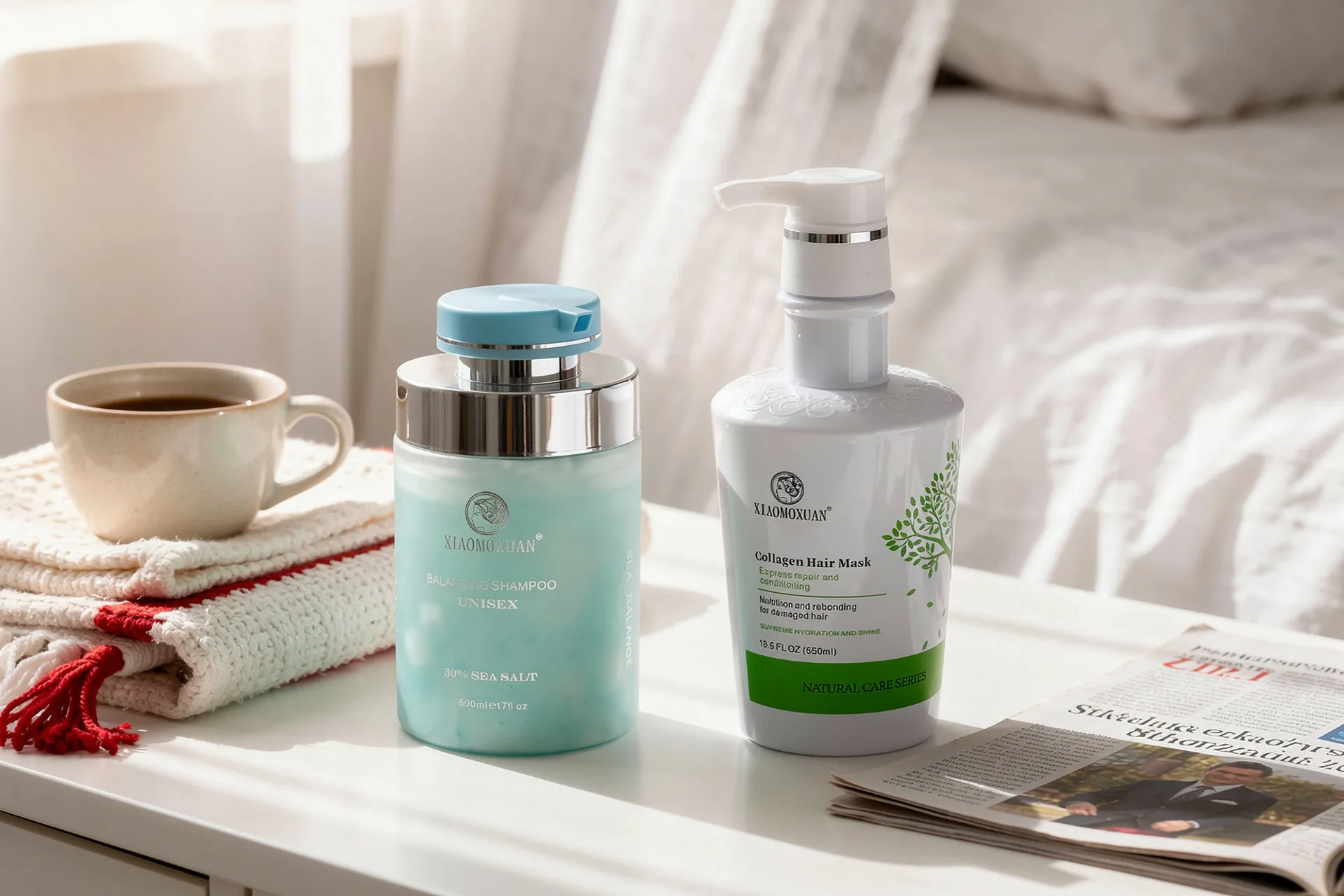
Shampoo is the first and most important step in caring for colour-treated hair. We explain what actually affects colour longevity — and how to read an ingredient list without the marketing noise.
Why shampoo matters more than your mask
Most people spend more attention on masks and conditioners — and less on shampoo. The logic is understandable: a mask “nourishes”, shampoo just “cleans”. But shampoo is what contacts your hair most frequently, and it’s the first thing that determines how long your colour lasts.
Every time you wash your hair, shampoo acts on the cuticle both mechanically and chemically — the outer protective layer of the hair shaft. If that action is aggressive, the cuticle opens, pigment washes out, and no mask can restore the colour that was lost during washing.
A mask restores what a shampoo may have damaged. But when the shampoo is right, a mask simply maintains and improves. Start building your haircare routine with shampoo — not with a mask.
Sulphates: why they destroy colour
Sulphates are surfactants that create lather and degrease hair. The most common ones are Sodium Lauryl Sulfate (SLS) and Sodium Laureth Sulfate (SLES).
For colour-treated hair they are problematic for two reasons:
-
They open the cuticle
Sulphates are alkaline. They raise the hair’s pH, causing the cuticle scales to lift. Through an open cuticle, pigment escapes with every wash. -
They dissolve the lipid layer
The cuticle is protected by a natural lipid layer. Sulphates break it down — hair becomes drier, more porous, and loses colour even faster. -
They directly wash out pigment
Some dyes — especially direct dyes (reds, purples, coppers) — are partially water-soluble. Sulphates accelerate their removal several times over.
SLES is a milder version of SLS, but still not ideal for colour-treated hair. If any ingredient ending in “Sulfate” appears in the list — that shampoo is not suited to regular use on colour-treated hair.
What replaces sulphates in good shampoos
Mild sulphate-free surfactants clean just as effectively without aggressively opening the cuticle. Look for these in the ingredient list:
| Ingredient name | Type | Suitable for colour-treated hair |
|---|---|---|
| Sodium Lauryl Sulfate (SLS) | Sulphate | No |
| Sodium Laureth Sulfate (SLES) | Sulphate | Not recommended |
| Cocamidopropyl Betaine | Amphoteric | Yes |
| Sodium Cocoyl Isethionate | Mild anionic | Yes |
| Decyl Glucoside / Coco Glucoside | Non-ionic (plant-based) | Yes |
| Sodium Lauroyl Sarcosinate | Mild anionic | Yes |
Shampoo pH and hair colour
pH is the measure of acidity or alkalinity. Healthy hair has a pH of 4.5–5.5 (mildly acidic). At this pH the cuticle is closed, lies flat, and colour is preserved.
Most standard shampoos have a pH of 6–8 — alkaline. This opens the cuticle. After every wash with such a shampoo, hair needs time and conditioner to return to its natural pH.
pH test strips are available from pharmacies and are inexpensive. Place a drop of shampoo on the strip. A reading of 4.5–5.5 is ideal for colour-treated hair. Above 6 and the shampoo will open the cuticle with every wash.
Shampoos marketed as “for colour-treated hair” usually fall within the correct pH range — but not always. The most reliable approach is to check, or to choose a brand that states its pH clearly on the packaging.
What to look for in the ingredient list
Beyond the absence of sulphates and a correct pH, a good shampoo for colour-treated hair contains active ingredients that further protect both colour and structure:
Hydrolysed collagen
Fills the micro-gaps of porous hair, densifying the shaft structure. The result: pigment escapes more slowly and hair looks fuller and shinier.
Panthenol (pro-vitamin B5)
Hydrates from within, reduces static and brittleness. Colour-treated hair is often dry — panthenol compensates for this without weighing hair down.
Tea tree extract
Soothes the scalp, which can be sensitive after the chemical process of colouring. Has mild antibacterial properties — useful for those prone to dandruff or irritation.
Plant oils (argan, jojoba, shea)
Restore the lipid layer of the cuticle that is broken down during colouring. Hair becomes softer, the cuticle lies flatter — and colour appears more saturated as a result.
UV filters
Sunlight fades colour-treated hair just as heat does. If you spend a lot of time outdoors, look for Benzophenone-4 or similar UV filters in the formula.
Ingredients are listed in descending order of concentration. If collagen or panthenol appear at the very end of a long list — there is very little of them in the formula. Look for products where the beneficial ingredients appear in the first half of the list.
3 marketing claims not to believe
“Protects colour 100%”
No shampoo stops colour from fading entirely — it’s physically impossible. A good shampoo slows down the process. “100% colour protection” is marketing without any evidence base.
“For all types of colour-treated hair”
Colour-treated hair varies enormously: freshly coloured and healthy, porous after many treatments, bleached, toned. A universal shampoo “for everyone” is a compromise that is optimal for no one. Choose based on the current condition of your hair, not a broad category.
“Natural = safe for colour”
Some natural ingredients — certain essential oils or citric acid at high concentrations — can interact with hair dye. “Natural” does not automatically mean “suitable for colour-treated hair”. What matters is the specific formula, not the marketing category.
How to wash colour-treated hair correctly
Even the right shampoo can’t compensate for poor washing technique. A few rules that will keep your colour lasting longer:
-
Wash less often — but properly
Every wash is stress for colour-treated hair. If possible, reduce frequency from daily to 2–3 times a week. Dry shampoo between washes is your ally. -
Use warm water, not hot
Hot water opens the cuticle just as alkaline shampoo does. Wash with warm water and finish with a cool rinse — cold water closes the cuticle and adds shine. -
Apply shampoo only to the roots
The scalp produces sebum and needs cleansing. The lengths will be rinsed clean as the shampoo runs through. Don’t work shampoo through your full length — it’s unnecessary stress for colour-treated ends. -
Don’t shampoo twice unless necessary
“Lather, rinse, repeat” is a standard instruction on shampoo bottles — but for colour-treated hair it isn’t relevant. One wash is sufficient when you’re washing regularly. -
Always follow with conditioner
Conditioner closes the cuticle that shampoo may have slightly opened — even with the right formula. It’s the final line of defence before your hair meets a towel and a hairdryer.
Xiaomoxuan shampoo for colour-treated hair
Sulphate-free and paraben-free. Formulated with mild surfactants, hydrolysed collagen and tea tree extract. Suitable for daily or regular use on colour-treated, bleached and chemically processed hair.
Frequently asked questions about shampoo for colour-treated hair
Can I use a regular shampoo on colour-treated hair?
You can, but your colour will fade significantly faster. Standard shampoos contain sulphates and have an alkaline pH — both factors open the cuticle and accelerate pigment loss. If your colour service is an investment, or you want to extend the life of your colour, switching to a sulphate-free shampoo makes a noticeable difference within just a few weeks.
When can I wash my hair after colouring?
It’s recommended to wait 48–72 hours after colouring. During this time the dye fully bonds inside the hair shaft. Washing earlier — especially with hot water — can cause some pigment to wash out before it has had a chance to set.
Can colour-treated shampoo be used on non-coloured hair?
Yes — and it’s often the better choice for everyone. Mild sulphate-free shampoos are less aggressive: they don’t dry out the scalp or strip the hair’s natural lipid layer. The only exception: if you have very oily hair and wash infrequently, a gentle shampoo may not give you the clean feeling you’re used to from a sulphate formula.
Do bleached or highlighted hair need a different shampoo?
Bleached hair is the most porous and the most vulnerable. A sulphate-free shampoo with collagen is a solid base, but if you’re noticing brassiness or yellow tones, add a purple or silver toning shampoo 1–2 times a week alongside your regular routine.
How much shampoo should I use?
For medium-length hair, about the size of a coin — roughly 2–3 cm in diameter. Sulphate-free shampoos lather less — this is normal and doesn’t mean they clean less effectively. Don’t increase the amount for the sake of lather: it’s just unnecessary stress on the hair.