
There’s one thing we notice in almost every other conversation about hair health. A woman describes her routine — a good shampoo, a mask once a week, a serum for the ends. And then she says: “But my hair is still dry, dull, breaking at the tips, and I have no idea why.”
The first question we ask: “Do you use heat protection?” The answer is almost always “no” or “sometimes, when I remember.” And there’s your answer.
What actually happens to your hair during styling — the honest truth
Picture this: you’re holding a curling iron heated to 390°F. And you’re pressing it against hair made of keratin proteins, moisture, and a thin protective layer called the cuticle.
The cuticle is the outermost layer of the hair shaft. It looks like scales lying tightly one over another. This smooth surface is what gives hair its shine and protects it from external damage.
What does heat do? It forces those scales open. Literally lifts them. Moisture evaporates, keratin deforms, and the scales no longer lie flat. Every styling session repeats this process — and each time, the cuticle recovers a little worse than before.
This is cumulative heat damage. It’s not visible after one session. But after a few months of regular styling without protection, hair looks like it desperately needs a major cut or a keratin treatment.
Important: heat damage is irreversible. Destroyed structure can’t be “healed” with a mask or serum. It can only be masked — and further damage can be prevented. That’s why protection always matters more than repair.
“But I don’t hold the iron on for long” — and other common misconceptions
“I don’t hold the iron on long — so the damage is minimal.” Even a few seconds of contact with a tool heated to 360–390°F is enough to alter the hair’s structure. And a blow dryer you use every day for 10–15 minutes is just as damaging — just slower.
“My hair is strong — it can handle it.” Strength isn’t the same as heat resistance. Thick, coarse hair may hold a style longer, but the keratin bonds inside are breaking down just the same as in fine hair.
“I rarely style my hair — I don’t need heat protection.” If “rarely” means 2–3 times a week, you do need it. Cumulative damage builds up even with infrequent styling — just a little more slowly.
“A weekly mask makes up for styling damage.” It doesn’t. A mask works on the surface and the ends, but it can’t restore heat-damaged bonds inside the hair shaft. Protection and repair are two completely different things.
What heat protection actually does — and why it’s more than just a “barrier”
The simplest explanation: heat protectant creates a barrier between your hair and the heat source. But a good product does much more than that.
- It locks in moisture. Glycerin, Hydroxyethyl Urea, and Panthenol seal water inside the hair shaft, preventing it from evaporating under heat. Hair stays hydrated even after blow drying.
- It distributes heat evenly. Without protection, heat is uneven — some sections get more, others less. A heat protectant evens out that distribution and reduces the risk of localised overheating.
- It nourishes hair while you style. Keravis, Amino Acids, and Hydrolyzed Keratin penetrate the cuticle while it’s open from heat and work from the inside. Styling becomes a restorative process rather than a damaging one.
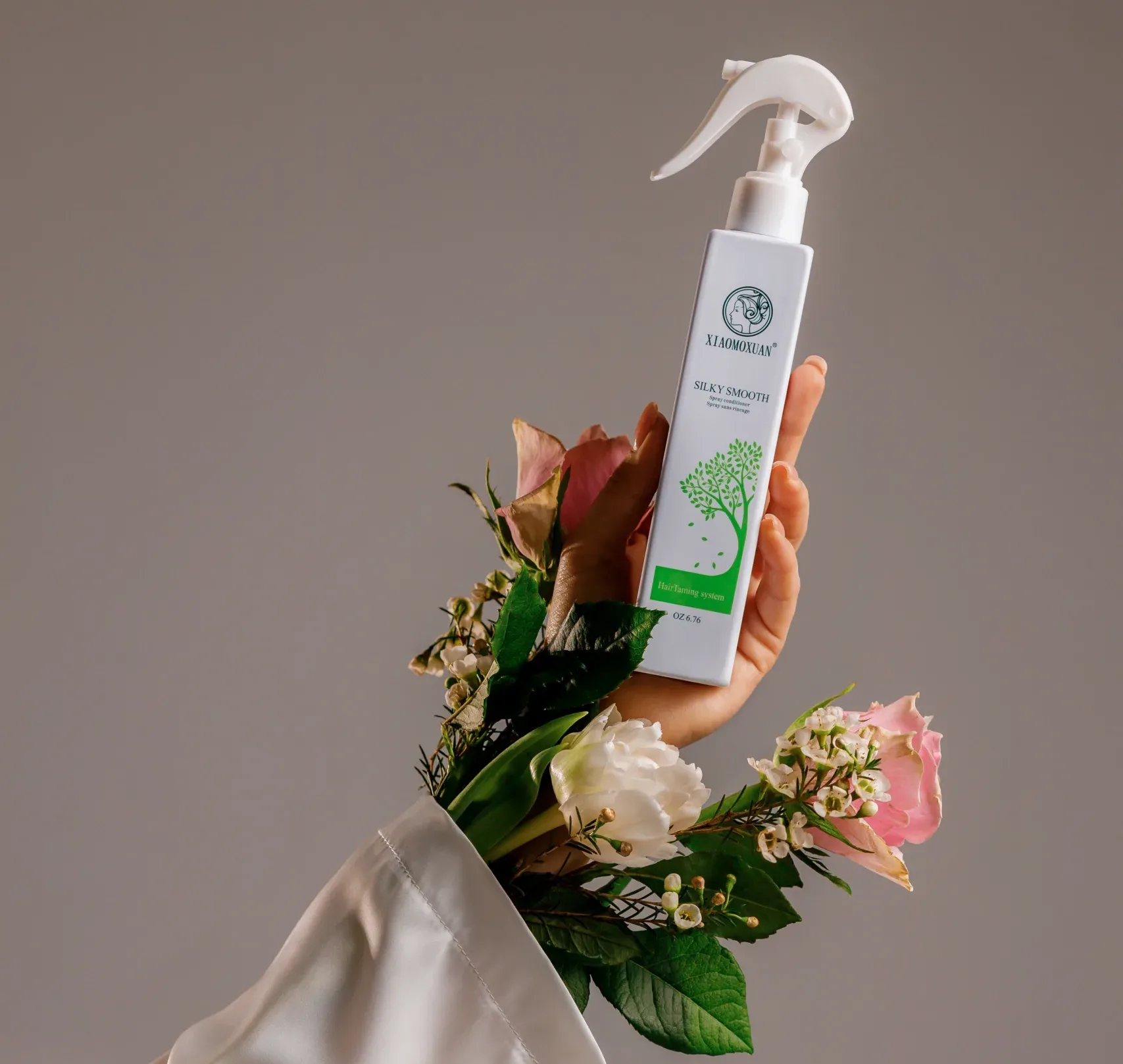
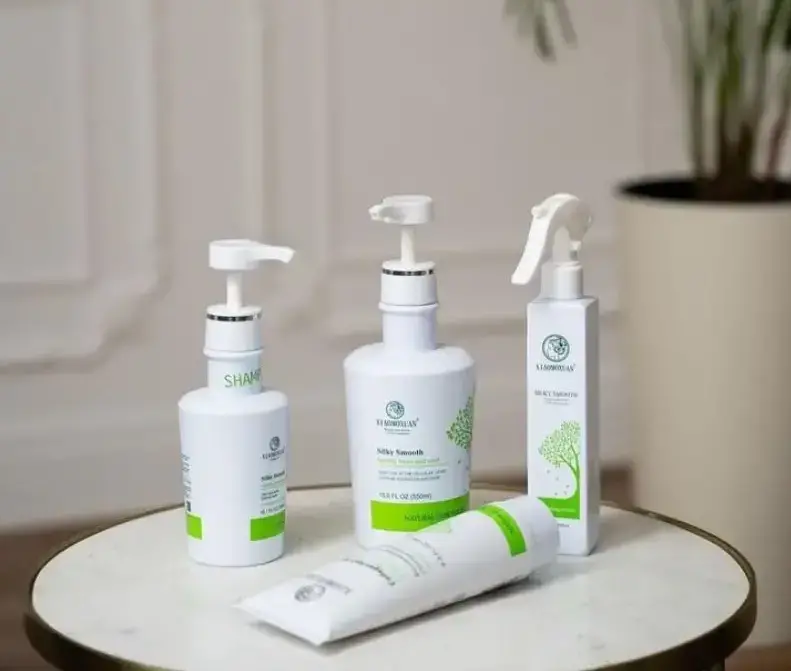
That’s exactly the principle behind our heat protection spray: protection and restoration — at the same time, not one after the other.
Protection and restoration — in one step
A conditioning heat protectant in a lightweight spray. No heavy silicone feel, with active nourishing ingredients.
What the difference looks like: hair before and after heat protection
We’re not fans of “before and after” promises — they’re too often exaggerated. But there are a few changes most people notice after a few weeks of consistent use:
- Ends stop frizzing after styling — they stay smooth and manageable.
- Hair holds its shape longer — a hydrated, protected structure keeps a style better.
- Less frizz in humidity — a sealed cuticle doesn’t let moisture from the air in.
- Shine looks more natural — a smooth cuticle surface reflects light evenly.
- Colour lasts longer — especially noticeable on coloured and lightened hair.
These changes don’t happen overnight. But they’re real and lasting — with consistent use.
“I’ve been using it for three weeks — my ends really have stopped frizzing after curling. I honestly didn’t think a spray could make that much of a difference.”
How to choose the right heat protectant
Look at the ingredients, not the claims
“Protects up to 450°F” on the label is a good start — but it’s not enough. An effective heat protectant contains:
- Amino acids and proteins (Amino Acids, Keravis, Hydrolyzed Keratin) — support the appearance of healthy hair, help make it more elastic, smooth, and visibly stronger. Especially valuable for dry or damaged hair.
- Moisturising ingredients (Hydroxyethyl Urea, Glycerin, Panthenol) — maintain softness, elasticity, and comfort along the length. Help reduce dryness.
- Film-forming polymers (copolymer, polyquaternium) — create a protective layer on the hair surface, help make it more manageable, smooth, and resistant to drying out during styling.
- Silicones (dimethicone, amodimethicone, dimethiconol) — smooth the surface, reduce friction, add shine, and control frizz.
If a product contains only silicones and fragrance — it’ll give a temporary smoothing effect, but won’t protect or restore the hair’s structure.
Consider your hair type
Fine hair: A lightweight spray without an oily texture. Moisturising ingredients and conditioning polymers.
Dry or damaged hair: Amodimethicone, Dimethicone, Keravis or amino acids — for smoothness and softness.
Colour-treated hair: Antioxidants and UV filters — to preserve colour between salon visits.
Curly hair: Moisturising ingredients and polymers. Frizz control without drying out.
Normal hair: A versatile leave-in conditioning spray. Softness, shine, no heaviness.
Check the temperature rating
For a blow dryer, protection up to 360°F is usually enough. For straighteners and curling irons, you need a product rated from 390°F and above. If you use both types of tools, look for protection up to 430–450°F. For more detail, see our Expert Tips on heat protection.
How to apply heat protectant correctly: 3 minutes that change everything
Even the best product won’t work if you apply it carelessly. But the right technique takes no more than three extra minutes in your routine.
-
Apply to slightly damp hair
Right after towel-drying. This is when the cuticle is open and most receptive to active ingredients.
-
Distribute from mid-length to ends
Avoid the roots if your hair is fine or prone to oiliness. For thick hair, divide into sections for even coverage.
-
Wait 1–2 minutes before styling
Almost everyone skips this step — and that’s a mistake. This is the time the protective layer actually forms.
-
Use the lowest effective temperature
Even with heat protection, excessive heat causes damage. For most styles, 320–360°F is more than enough.
Xiaomoxuan tip: if your hair looks weighed down or feels sticky after styling — you’re most likely using too much product. Try halving the amount and see how it looks. Getting the quantity right is the key to a light, voluminous finish.
The right approach to styling starts with this one step
Xiaomoxuan heat protectant is designed for everyday use — lightweight texture, no heaviness, with active care ingredients.
Heat protection and colour-treated hair: why it matters even more
Chemical processing has already changed your hair’s structure. During colouring, the cuticle is forced open — and it never closes back as tightly as it was before. Colour-treated hair is inherently more porous, more vulnerable to moisture, heat, and external stressors.
What does heat do to porous hair? It accelerates colour fade. It oxidises the dye molecules. It breaks down the keratin bonds that are already weakened from the colouring process.
The result: colour looks dull after 2–3 weeks instead of the expected 6–8. Hair becomes dry and frizzy between appointments. And each subsequent colouring session becomes less predictable.
Heat protectant addresses this on several levels at once: it seals the cuticle, locks in pigment, and nourishes the weakened structure. Look for products labelled “for colour-treated hair” and check the ingredients for antioxidants and UV filters.
Styling doesn’t have to be a choice between looking good and healthy hair
With the right heat protection, it’s the same thing. That’s why we made ours not just protective, but actively nourishing — so every styling session works for your hair, not against it.
If you style your hair every day or several times a week, heat protectant is the product you’ll use more often than any mask or serum. We decided to make that daily ritual a moment of active restoration too.
The Xiaomoxuan formula helps protect hair during styling, maintains moisture and elasticity, adds softness and smoothness along the length. The results aren’t instant — but they’re cumulative. After a few weeks of regular use, hair becomes noticeably more elastic, shinier, and less prone to breakage.
Your plan for this week
- Check whether you have a heat protectant — and whether you’re actually using it consistently
- Look at the ingredients: are there amino acids, moisturising components, and polymers?
- Try applying to damp hair and waiting 2 minutes before blow drying
- Lower your tool temperature by 20–40°F from what you normally use
- If your hair is colour-treated — make sure the product contains UV filters
Frequently asked questions about heat protection
Do I need heat protection when using a blow dryer?
Yes. A blow dryer works on a large section of hair over an extended period — especially if you use it every day. Even moderate heat causes cumulative damage with daily use. Heat protection before blow drying is a basic necessity, not an optional extra.
How often should I apply heat protectant?
Every time before any heat styling — blow dryer, straightener, or curling iron. If you style daily, apply it daily. If 2–3 times a week, apply it those days.
Is heat protectant suitable for an oily scalp?
Yes. Apply the product to the lengths only, starting 2–3 inches from the roots. A lightweight spray formula won’t weigh hair down or trigger oiliness — the key is not using too much.
Can I apply heat protectant to dry hair?
Technically yes, but it’s less effective. On damp hair, the cuticle is open and absorbs active ingredients better. Applying to dry hair before curling is better than nothing — but ideally, use it on damp hair before blow drying.
Will heat protectant weigh my hair down?
If you’re noticing heaviness, it’s usually a question of how much you’re using, not the product itself. Start with a small amount and adjust as needed. Lightweight spray formulas are barely noticeable on the hair.
Make heat protection part of your routine — starting today
Your hair will feel the difference within 2–3 weeks of consistent use. No drastic changes — just one right step.
Read more in our Expert Tips: heat protection guide and heat protection for colour-treated hair.