
Colour-treated hair and daily heat styling — a bad combination without the right protection. We explain exactly what happens to your colour under heat and how to stop it.
What is heat protection for colour-treated hair?
Heat protection for colour-treated hair is a product that forms a protective film on the surface of the hair shaft, preventing the cuticle scales from lifting under the influence of heat. This slows down pigment loss when using a hair dryer, curling iron, or flat iron, and helps maintain colour vibrancy between dyeing sessions.
Why colour-treated hair is more vulnerable
Every time you colour your hair, the chemical process opens the cuticle — the outer protective layer of the hair shaft. The dye penetrates inside, but the hair’s structure is no longer as dense as it was before colouring.
Colour-treated hair has increased porosity: the cuticle scales lie less flat, leaving micro-gaps between them. Through these gaps, hair loses both moisture and pigment more quickly — especially under heat.
The more often you colour your hair, the more porous its structure becomes. After 3–4 colour treatments without restorative care, the cuticle can be so open that the protective effect of heat products is reduced. A regular collagen mask helps to partially restore the density of the hair shaft.
What heat does to your colour
The mechanism is straightforward: heat expands the structure of the hair shaft. The cuticle scales lift, and the pigment — dye molecules inside the cortex — finds an exit. When the hair cools, the scales close again, but some pigment has already escaped and been washed away.
This doesn’t happen all at once — it happens gradually with every styling session. That’s why hair “fades”: the colour doesn’t disappear suddenly, it simply becomes duller after each wash and each session with a hairdryer or curling iron.
You’ve just coloured your hair a rich chestnut brown. Two weeks later you notice that the roots look darker than the ends — yet there’s no real regrowth yet. It’s not regrowth: the ends are simply losing pigment faster because they are older and more porous. Heat from a curling iron accelerates this process several times over.
At what temperature does damage begin
Hair begins to alter its structure at 150°C and above. Most styling tools operate well above this threshold:
| Tool | Working temperature | Risk to colour-treated hair |
|---|---|---|
| Hairdryer (high setting) | 80–120°C | Medium |
| Curling iron | 150–230°C | High |
| Hair straightener | 180–230°C | Very high |
| Hot air brush | 100–150°C | Medium |
| Diffuser (low setting) | 60–80°C | Low |
If you can’t give up your curling iron or straightener — lower the temperature to 160–170°C and always use a heat protectant. The difference between 180°C and 160°C is noticeable for hair colour within just a few weeks.
What to look for in a heat protectant
Not all heat protectants are equally effective for colour-treated hair. There are a few key ingredients that genuinely make a difference:
Silicone polymers (dimethicone, cyclomethicone)
They form a thin film on the surface of the hair shaft that reflects heat and prevents the cuticle scales from lifting. This is the first line of defence when the hair comes into contact with a hot tool.
Hydrolysed collagen
It penetrates the micro-gaps of porous hair and temporarily “fills” them. This is especially important for colour-treated hair — a denser structure means the pigment escapes more slowly even when heat is applied.
Panthenol (pro-vitamin B5)
It hydrates and softens the hair shaft from within, reducing brittleness. Colour-treated hair often suffers from dryness — panthenol compensates for this effect.
Tea tree extract
It soothes the scalp, which can be irritated after colouring, and has mild antibacterial properties. In combination with collagen it creates a synergistic strengthening effect.
Avoid products containing sulphates and parabens in conditioners and styling sprays. Sulphates open the cuticle, neutralising the protective effect of even a good heat protectant.
How to apply heat protection correctly
Even a good product won’t deliver results if used incorrectly. Here is a step-by-step routine:
-
Wash your hair with a sulphate-free shampooSulphate shampoos open the cuticle — everything you apply afterwards is absorbed less effectively.
-
Apply a mask or conditionerA collagen mask fills the porous structure of colour-treated hair. Leave it on for 5–10 minutes, then rinse with cool water — cold water closes the cuticle.
-
Gently blot dry with a towel — don’t rubRubbing with a towel mechanically damages the open cuticle scales. Gently press or wrap for 2–3 minutes.
-
Apply the heat protection spray to damp hairSpray evenly from mid-length to the ends — these sections are the most porous and most vulnerable. The roots don’t need as much heat protection.
-
Wait 1–2 minutes before stylingLet the ingredients settle on the hair — don’t reach for the hairdryer straight after applying.
-
Dry and style at the lowest possible temperatureHeat protection reduces damage but does not eliminate it entirely. Lower temperature + protection = the best result for your colour.
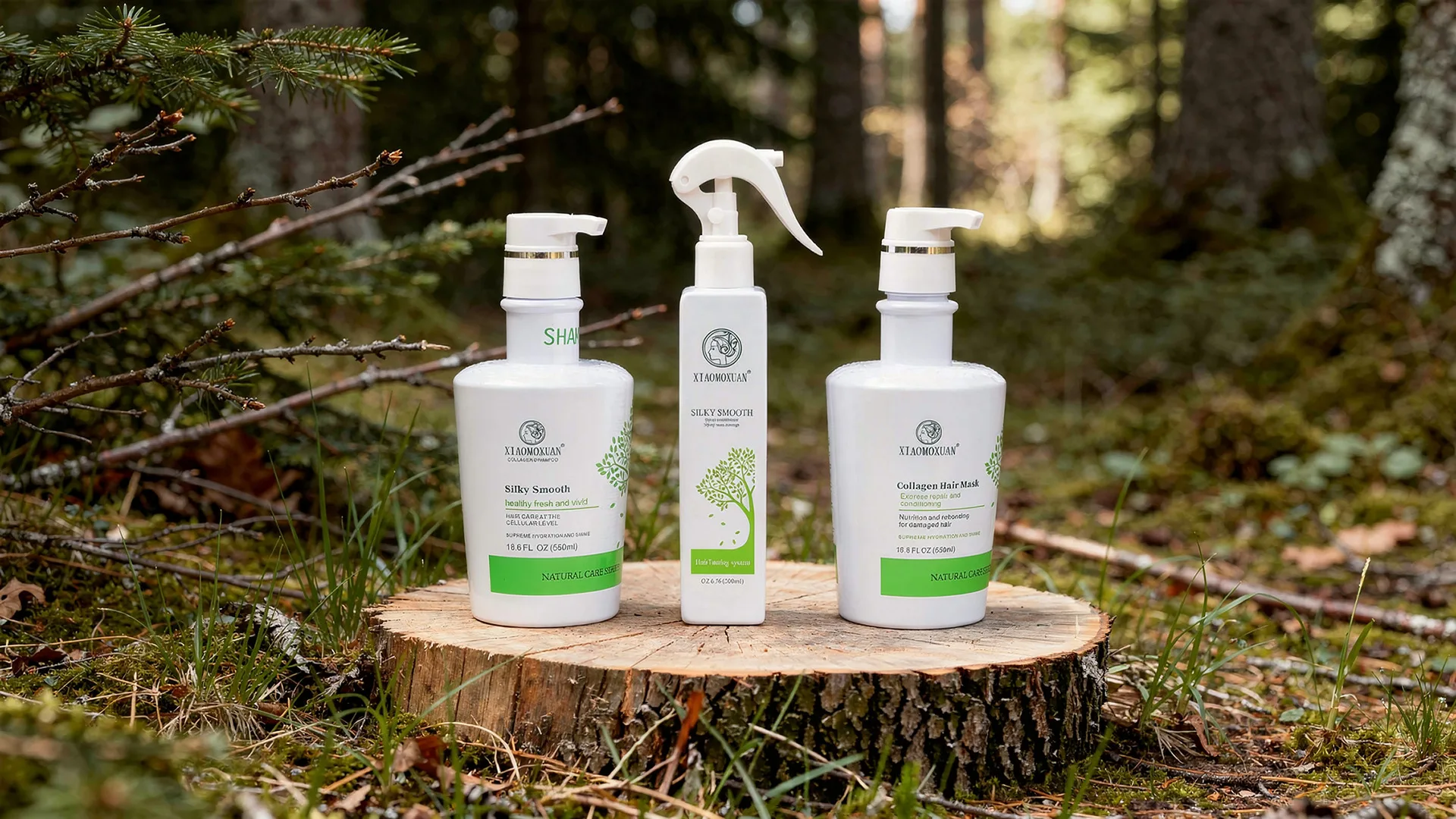
Silky Smooth by Xiaomoxuan
A leave-in conditioning spray with collagen and tea tree extract. Apply to damp or dry hair before styling — no weighing down. Suitable for colour-treated, brittle and chemically processed hair.
Frequently asked questions about heat protection
Do I need heat protection when using a hairdryer?
Yes. A hairdryer acts on a large portion of your hair for an extended period — especially if you dry it every day. Even moderate heat accumulates damage with daily use. Heat protection before blow-drying is a basic necessity, not an overreaction.
How often should I apply heat protection?
Every time before any heat exposure — hairdryer, straightener, curling iron. If you style your hair every day, apply protection every day. If 2–3 times a week, apply it accordingly.
Is heat protection suitable for oily scalp types?
Yes. Apply the product only to the lengths, keeping 5–10 cm away from the roots. A light spray texture does not weigh hair down or trigger oiliness — just make sure not to apply too much.
Can heat protection be applied to dry hair?
Technically yes, but the effectiveness is lower. On damp hair the cuticle is open and absorbs active ingredients better. Applying to dry hair before a curling iron is better than nothing, but ideally apply to slightly damp hair before blow-drying.
Does heat protection weigh hair down?
If you feel any heaviness — it’s usually a matter of quantity, not the product itself. Start with the minimum amount and increase as needed. Light spray formulas are barely noticeable on the hair.